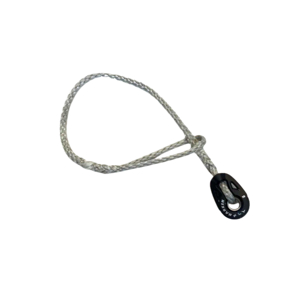
Before reading this article, we strongly recommend you read our Introduction to Sailing Purchase Systems article. It will help understand how they work and how different systems affect the amount of line you will need to pull and the mechanical benefit - there is always a trade-off.
ILCA Class System Lines and Blocks Rules
The type of lines and blocks that you can use on an ILCA system are governed by PART 2 > Rule 3(a): Control Systems, Control Lines, and Fittings > Control Systems Definitions, of the ILCA Class Rules, which state the following (in PDF version):
The Cunningham, outhaul, vang, traveller, and mainsheet are the Control Line Systems. The Cunningham, Outhaul, and Vang Control Line Systems may include more than one Control Line as allowed in Rules 3(d)i, 3(e)i, and 3(f)
Each Control Line shall be a single piece of uniform thickness and material. A line is a Control Line if any of the line moves along its axis during the adjustment of the Control Line System. A line that exclusively attaches items together is a Tie Line.
In addition, PART 2 > Rule 3(a): Control Systems, Control Lines, and Fittings > Control Lines and Fittings, states the following:
Control lines shall be natural or synthetic rope.
Control lines shall be of uniform thickness, but may vary in thickness for the purpose of a splice at the load-bearing attachment point.
iii. In a control line system where more than one control line is permitted, lines of different diameters shall not be joined together.
iv. “Optional” blocks allowed in Cunningham, Vang, or Outhaul control systems shall have sheaves of diameter not less than 15 mm and not more than 30 mm. Thimbles allowed to reinforce rope loops used as “Turning Points” in the Cunningham, Van,g and Outhaul control line systems shall not exceed 40mm in length.
v. Only single or double “Optional” blocks shall be used. A single block means a block with one sheave; a double block means a block with two sheaves. “Optional” blocks may include a becket, a swivel, and/or a shackle.
ILCA Class Outhaul Rules
The ILCA class rules on the Outhaul system are found in ILCA CLASS Rules > PART 2, Rule 3(f): Outhaul. This PDF version is easier to read. Here is a summary of the Outhaul's specific requirements.
The outhaul system shall consist of a maximum of two control lines, “Optional” blocks or loops for purchase, and a maximum of 6 “TurningPoints”.
The outhaul control line shall be attached to either the end of the boom, the outhaul fairlead, the sail, or a quick-release system, and shall pass through the boom outhaul fairlead as a moving line at least once. The outhaul fairlead shall be at least one of the maximum of 6 “Turning Points” permitted by Rule 3(f)i.
Additional purchases may be obtained by forming rope loops in the line or adding “Optional” blocks to the line, and/or using the outhaul fairlead, the outhaul clam cleat, the boom, the mast, or the gooseneck fitting. An “Optional’ block may be attached to the outhaul fairlead, provided Rule 3(f)ii is also satisfied. An “Optional” block may be attached to the outhaul clam cleat.
An “Optional” block may be attached to the clew of the sail, or to a quick-release system, or be part of a quick-release system.
One or two “Optional” blocks may be attached to the gooseneck fitting, or at the mast/gooseneck junction with their “Turning Points” not more than 100 mm from the center of the gooseneck bolt (the gooseneck may be inverted). The blocks in this rule may also be attached to the gooseneck with a bolt or a pin.
A shock cord may be used as an inhaul on the clew.
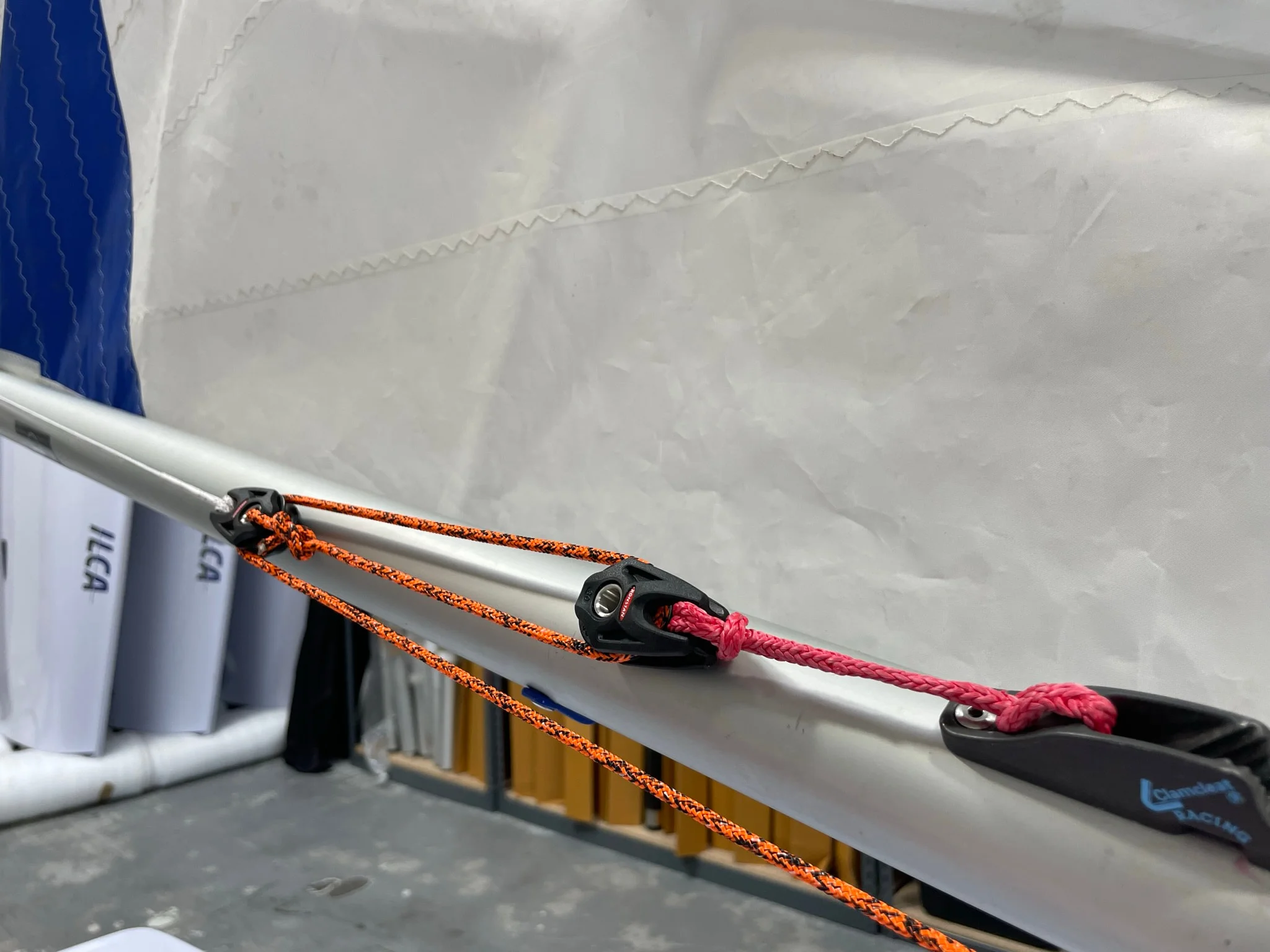
Shock cord and/or rope loops (rope loops may be part of the control line) can be tied around the boom and/or the outhaul control lines to retain the outhaul lines close to the boom.
Deck Led Outhaul System. When led to the deck, the outhaul control line shall pass only once through the Cunningham fairlead or the outhaul “Optional” single block attached to the “Builder Supplied” deck block fitting, and shall pass only once through the “Optional” cam cleat attached to the “Builder Supplied” deck cleat base. The boom outhaul clam cleat shall not be removed.
As you can see, the exact purchase ratio allowed by the class rules is not explicitly stated. Class-legal Cunningham systems are commonly available in 2:1, 4:1, and 6:1 purchase ratios.
Outhaul Lines
To build an Outhaul System, you will need three different types of lines, two different types of blocks, and a clew shackle, depending on the system you want to build. The thickness and type of line depend on your preference and are usually 3, 4, or 5 mm in diameter. A 24 ft. control line will accommodate a 2:1 to a 6:1 system. We recommend any of the following lines.
#
Line
Use
Material
Diam.
Length
No
Notes
Recommendations
1
Outhaul Control Line
This is the line you will hold on your hands and run through the Cam Cleat, Deck Block, and back through the boom to the outhaul block.
Dyneema Core Poly Double Braided
3 mm, 4mm, or 5 mm
24 ft.
1
The Robline Dinghy control is softer than the PolyTech or Marlow lines. Since the line runs through blocks (no friction), there is no major impact on durability.
We like Harken blocks in general, but Ronstand blocks will be just fine as well. The blocks you choose must fit the diameter of the control line you prefer and must be no smaller than 15 mm or no larger than 30 mm (per the ILCA Class Rules). The block sizes we recommend are based on a max. 5 mm control line. If you are using a smaller line, you can use smaller blocks - always check the max. line size, block load, and sheave size. Here are the blocks we recommend.
#
Block
Use
Options
Size
No
Notes
Recommendations
1
Primary System Blocks
These are the main blocks of the purchase system and will be used on the sail and mast sides.
These blocks will be used as the secondary (lower blocks) on a multi-block setup. You can not splice two of them together; they have to be spliced into a bigger block.
The block should fit a 5 mm line and should be small. We recommend a 16 mm block. The forkhead block will go into any clew shackle. The regular block requires a removable bar.
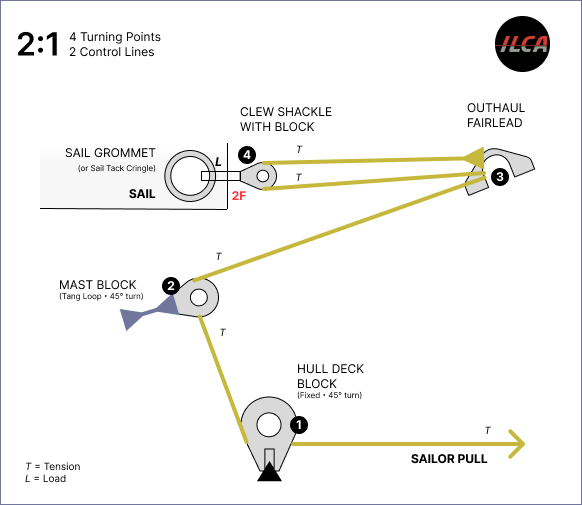
This is the most basic system. It requires a spliced Dyneema anchor line and block on the sail side, which runs through the sail’s grommet and attaches to the vang system or another anchor point on the hull. The control line is attached to the same anchor point on the vang system or haul and runs through the block and then the haul control lines block. Pre-made 2:1 systems are not usually available for purchase.
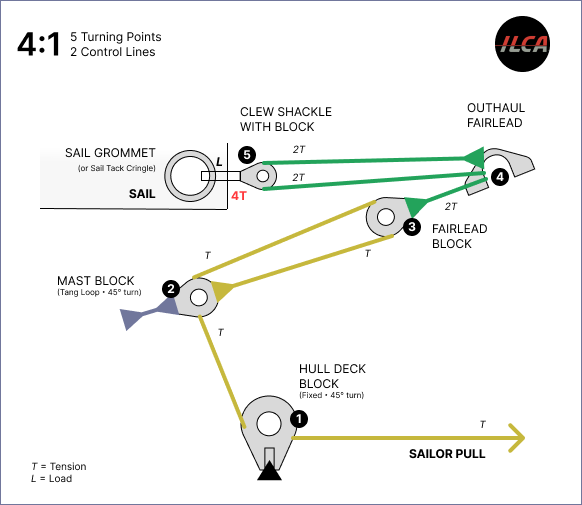
4:1 Outhaul System
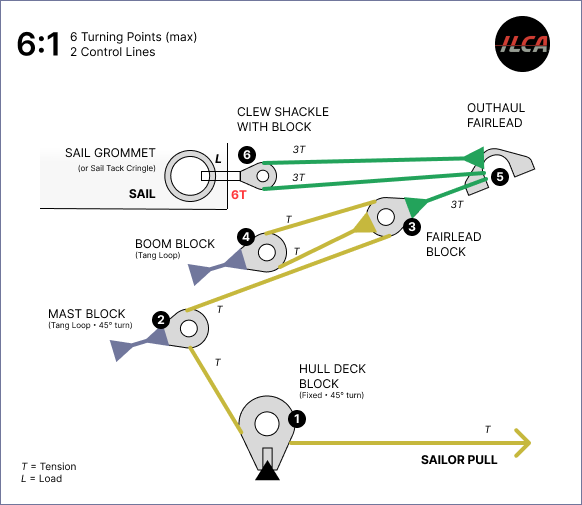
To build a 6:1 system, you add a 32 block on a Dyneema ‘tang loop’, which is a piece of rope passed through the hole in the tang and then tied, spliced, or looped back onto itself. This secondary block should be the same size as your sail side block, and should be attached to the lowest section of the lower mast before you put the mast in. Pre-made 4:1 systems are not usually available for purchase. Sailors use a 6:1 system, skipping the boom block when rigging.
6:1 Outhaul System
To build an 8:1 system, you add one more smaller block to the sail side block. The additional block should preferably be smaller to keep the lines from touching. However, it should not be less than size 18 to allow you to use up to a 5 mm control line. The control line will now attach to the lower mast block.